
Research
Each summer, the Adirondack Center for Loon Conservation trains a dedicated field team that collects vital information about breeding loons across the Adirondack Park. Each staff member is assigned a group of lakes they visit weekly, and records the presence, nest efforts, and number of chicks raised by loons in each territory. Over time, these observations help us identify population trends and how a variety of stressors may be influencing Adirondack loons.
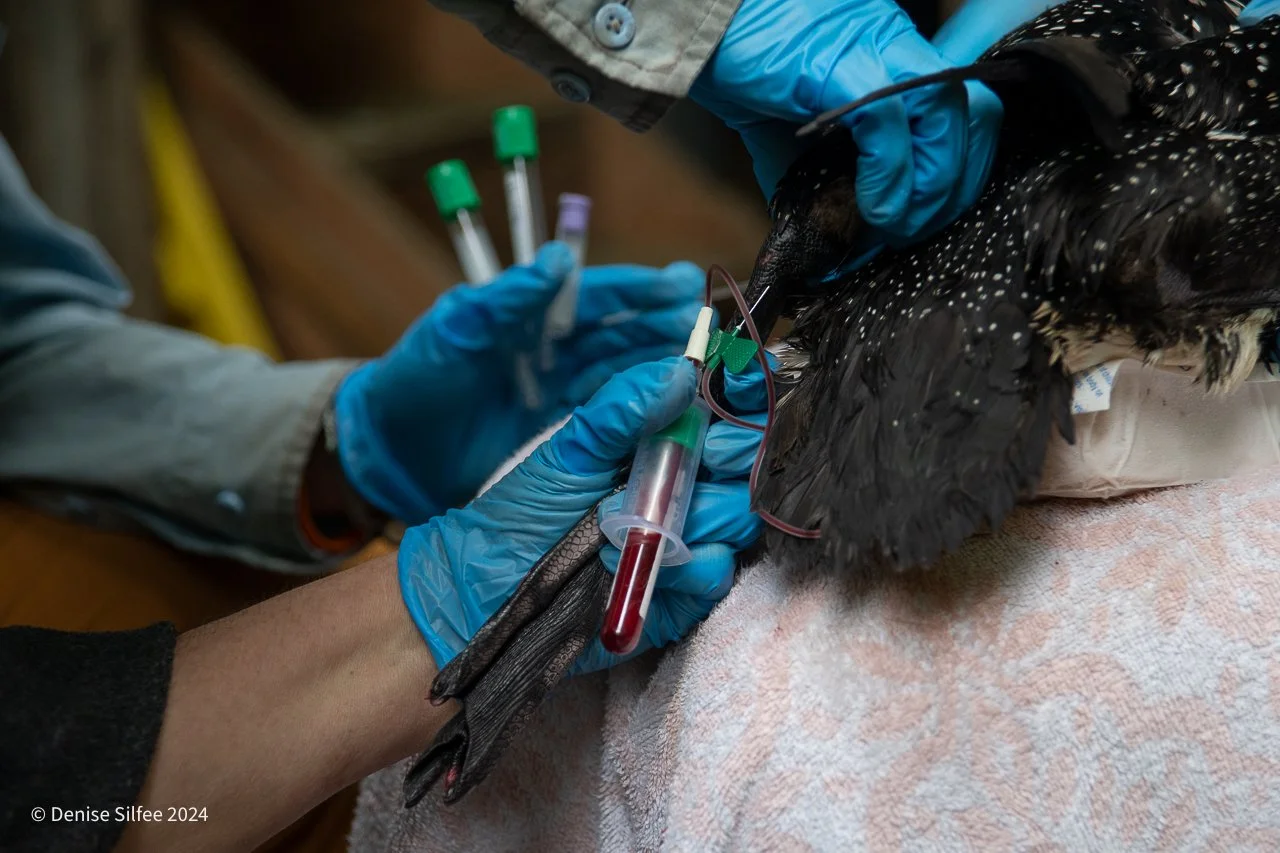
Many of the loons we study are individually marked with a unique combination of colored leg bands placed by researchers during capture and banding. These bands let us follow the lives of specific birds over many years and answer important questions such as the life span of a loon, who they mate with, how pollutants such as mercury accumulate and affect individuals over time, and the quality of territories that pairs compete for.
Experience loon banding week and learn about ACLC’s mercury research in this mini-documentary from ACLC’s 2026 Environmental Storytelling Intern, Chris Peirce.
Research Areas
-
The Adirondack Center for Loon Conservation studies how well Common Loons are able to nest and raise chicks in the Adirondack Park and what gets in their way.
Since 2013, we have deployed motion-activated cameras at selected loon nests. These cameras quietly record thousands of images throughout the breeding season, allowing us to see what happens at the nest without disturbing the birds.
From over 325,000 photos over the past 13 years, we’ve learned more about loon behavior, clutch size, hatch dates, and how often nests are disturbed or preyed upon. The cameras have even revealed previously unknown threats, such as black bears raiding nests, and helped us track how stronger, more frequent storms and changing water levels affect nesting success.
This research directly guides how we protect loon nests in the Adirondacks. By sharing these images and stories with shoreline homeowners and visitors, we can show what disturbance looks like—and how giving loons space can help chicks safely hatch and thrive.
-
Common Loons (Gavia immer) are indicators of how air pollution impacts lakes and ponds in New York’s six-million-acre Adirondack Park.
Since 1998, ACLC and its partners have monitored the Adirondack loon population to measure exposure to mercury, a toxic pollutant that harms wildlife and people. Early research showed a clear pattern: loons with higher mercury levels have lower reproductive success than loons with low mercury exposure.
Stronger air emissions regulations, including the Clean Air Act Amendments of 1990 and the Mercury and Air Toxics Standards, have since reduced airborne mercury and acid rain, which has helped many previously acidic and mercury-laden Adirondack lakes begin to recover. As mercury and acid deposition declined across the Northeast, mercury levels in Adirondack loons leveled off after 2010 and previously acidified lakes began to recover.
Today, mercury and acid rain are no longer the primary factors limiting loon reproductive success in the region, though they remain a significant concern if emissions regulations were to be relaxed. This long-term research highlights how policy changes can improve ecosystem health—and how loons help us track the ongoing effects of environmental change.
-
We are seeing the impacts of climate change on breeding loon pairs in real time in the Adirondacks. More frequent torrential rainstorms can flood shoreline nests, washing away eggs and causing nest failure. Warmer winters are also changing ice patterns on Adirondack lakes. When lakes freeze later, some loons delay migration. If they are still present during their winter wing molt (when they cannot fly) and the lake suddenly freezes, they can become trapped in the ice, a growing problem known as “molt-migration mismatch.”
Climate change may also expose loons to new diseases, such as avian malaria, as warmer temperatures allow disease-carrying insects to expand their range northward. In addition, rising temperatures during nesting season could push the species’ breeding range farther north as warmer temperatures force incubating loons back into the water, reducing nest success and making the Adirondack Park, already near the southern edge of that range, an “ecological sink” in which more birds die or fail to reproduce than are replenished into the population through reproduction and immigration.
These combined pressures put the future of Adirondack loons at risk and highlight the urgent need for climate action and conservation.
Spotted a loon?
Add your sighting to the NY Loon Observation Reporting Tool, an interactive map helping us track where we see loons!
This is a new feature, and we plan to use reported loon sightings to create an interactive map that shows where loons have been spotted in the near future.
Community Science
Collecting data and contributing to a greater understanding of our shared environment is a community effort. The following studies and initiatives rely on community participation. Read more to learn how to participate.
NY Annual Loon Census
The NY Annual Loon Census has been held on the 3rd Saturday of July each year for one hour since 2001.
During the census, volunteers across the state of New York observe loons on their assigned lake and report their observations to ACLC. This data provides an annual "snapshot" of the breeding loon population in the state. Results of the census over time provide valuable information regarding the status and trends in New York's summer loon population.
People all across the state are invited to participate in the Annual Loon Census and submit their observations from any lake in New York.
-
The NY Annual Loon Census has been held on the 3rd Saturday of July each year for one hour since 2001.
During the census, volunteers across the state of New York observe loons on their assigned lake and report their observations to ACLC. This data provides an annual "snapshot" of the breeding loon population in the state. Results of the census over time provide valuable information regarding the status and trends in New York's summer loon population.
People all across the state are invited to participate in the Annual Loon Census and submit their observations from any lake in New York.
-
I am a NEW census volunteer.
How to sign up:
Sign up on the Census Sign-Up Map.
I WAS a census volunteer -am I still signed up?
If you submitted data in 2025, you are automatically signed up for 2026. If you need to cancel your assignment or change your lake assignment, email research@adkloon.org.
If you participate under the guidance of a volunteer coordinator on a large and/ or private waterbody, please check in with them to determine the area that you are assigned to for 2026. ACLC does not manage sign-ups on waterbodies with volunteer coordinators, and if you participate on one of these waterbodies, you may not be automatically assigned to the same area for 2026.
I want to CHANGE my lake.
Email research@adkloon.org to change your lake assignment.
If you are signed up through a volunteer coordinator on a large and/ or private waterbody, please contact them. ACLC does not manage sign-ups on waterbodies with volunteer coordinators.
I want to CANCEL my registration.
Email research@adkloon.org to change your lake assignment.
If you are signed up through a volunteer coordinator on a large and/ or private waterbody, please contact them. ACLC does not manage sign-ups on waterbodies with volunteer coordinators.
-
Boat Impacts Study
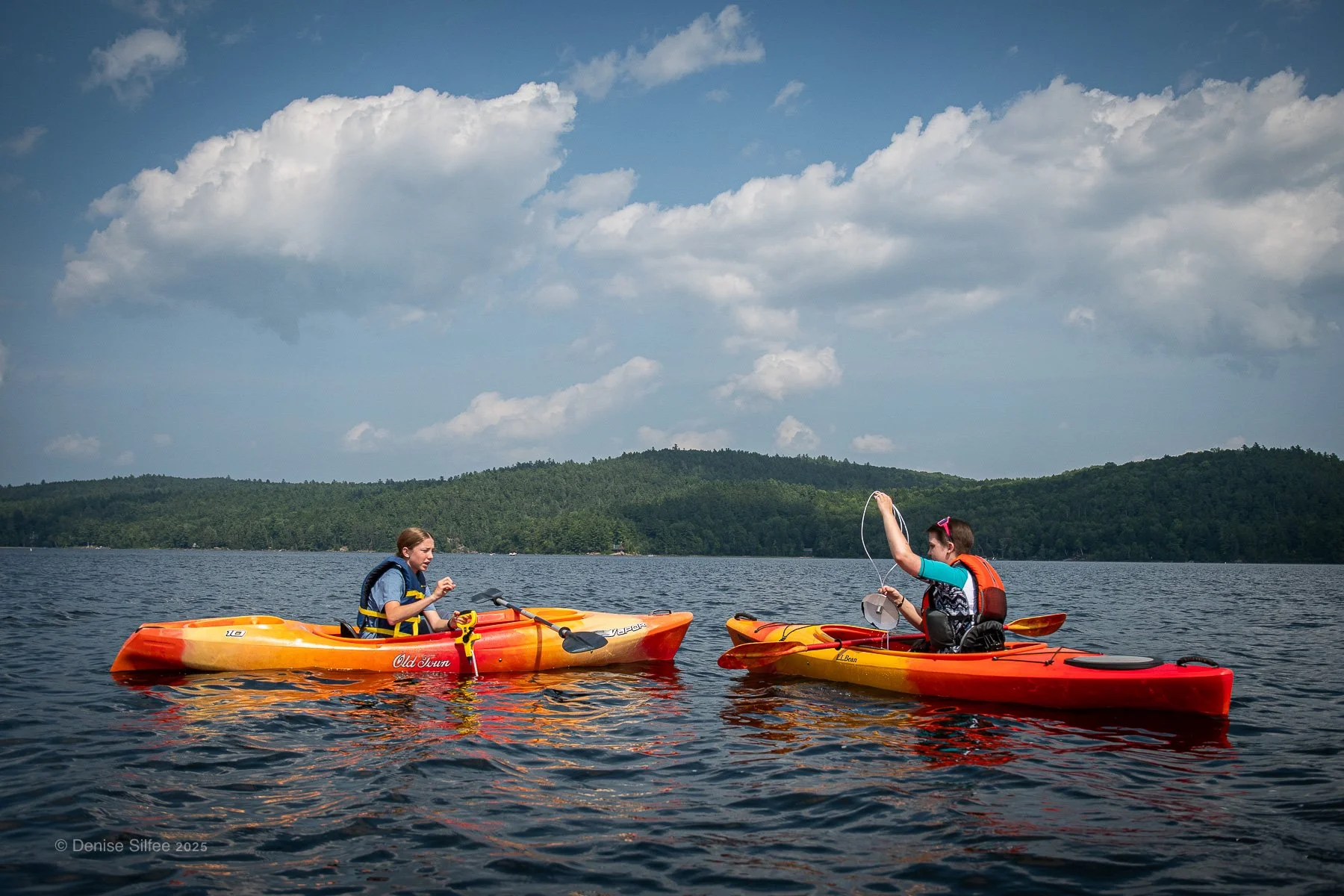
This new study is being rolled out in 2026 to the public. It relies on community science volunteers to help us collect information about what types of boats are present on water bodies throughout the Adirondack Park and beyond.
Publications
Adams, E. M., J. A. Gulka, Y. Yang, M. E. H. Burton, D. A. Burns, V. Buxton, L. Cleckner, C. R. DeSorbo, C. T. Driscoll, D. C. Evers, N. Fisher, O. Lane, H. Mao, K. Riva-Murray, G. Millard, N. R. Razavi, W. Richter, A. K. Sauer and N. Schoch. 2023. Distribution and trends of mercury in aquatic and terrestrial biota of New York, USA: a synthesis of 50 years of research and monitoring. Ecotoxicology. 32: 959-976.
Evers, D.C., E. Adams, M. Burton, J. Gulka, A. Sauer, and C. T. Driscoll. 2019. New York State Mercury Connections: the Extent and Effects of Mercury Pollution in the State. Biodiversity Research Institute. Portland, Maine. BRI Science Communications Series 2019-12-2. 41 pages.
Paruk, J. D. E. M. Adams, H. Uher-Koch, K. A. Kovach, Darwin Long IV, C. Perkins, N. Schoch, and D. C. Evers. 2016. Polycyclic aromatic hydrocarbons in blood related to lower bodymass in common loons. Science of the Total Environment. 565: 360–368.
Schoch, N., A. Jackson, M. Duron, D.C. Evers, M. Glennon, C.T. Driscoll, J. Ozard, and A. Sauer. 2014. The impact of mercury exposure on the common loon (Gavia immer) population in the Adirondack Park. Waterbirds. 37 (Special Publication 1): 133-146.
Schoch, N., A. Jackson, M. Duron, D.C. Evers, M. Glennon, C.T. Driscoll, X. Yu, H. Simonin, and A. Sauer. 2014. Wildlife criterion value for the common loon in the Adirondack Park, New York State. Waterbirds. 37 (Special Publication 1): 76-84.
Spilman, C.A., N. Schoch, W. F. Porter, and M. Glennon. 2014. The effects of lakeshore development on common loon productivity in the Adirondack Park, New York. Waterbirds. 37 (Special Publication 1): 94-101.
Gray, C.O., J.D. Paruk, C.R. Desorbo, L.J. Savoy, D.E. Yates, M.D. Chickering, R.G. Gray, K.M. Taylor, D. Long IV, N. Schoch, W. Hanson, J. Cooley, and D.C. Evers. 2014. Bodymass in common loons (Gavia immer) is strongly affected by migration distance. Waterbirds. 37 (Special Publication 1): 64-75.
Schoch, N., A. Jackson, M. Duron, D.C. Evers, M. Glennon, C.T. Driscoll, X.Yu, and H. Simonin. 2011. Long-term monitoring and assessment of mercury based on integrated sampling efforts using the common loon, prey fish, water and sediment. Biodiversity Research Institute, Gorham, Maine. Report BRI 2011-28 to the New York State Energy Research and Development Authority for NYSERDA EMEP Project #7608. 116 pages.
Evers, D.C., K.A. Williams, M.W. Meyer, A.M. Scheuhammer, N. Schoch, A. Gilbert, L. Siegel, R.J. Taylor, R. Poppenga, and C.R. Perkins. 2011. Spatial gradients of methylmercury for breeding common loons in Laurentian Great Lakes region. Ecotoxicology 20: 1609–1625.
Yu, X., C.T. Driscoll, D.C. Evers, M. Duron, N. Schoch, and N. Kamman. 2011. Spatial patterns of mercury in biota of Adirondack, New York lakes. Ecotoxicology 20: 1543–1554.
Kenow, K.P. D. Adams, N. Schoch, D. C. Evers, W. Hanson, D. Yates, L. Savoy, T. J. Fox, A. Major, R. Kratt, J. W. Ozard. 2009. Migration patterns and wintering range of common loons breeding in the Northeastern United States. Waterbirds32(2): 234-247.
Evers, D.C., L. Savoy, C. DeSorbo, D.E. Yates, W. Hanson, K.M. Taylor, L. Siegel, J.H. Cooley, Jr., M.S. Bank, A. Major, K. Munney, B. Mower, H.S. Vogel, N. Schoch, M. Pokras, M.W. Goodale, and J. Fair. 2008. Adverse effects from environmental mercury loads on breeding loons. Ecotoxicology. 17:69–81.